In this guide
- Why Water Damage Deserves Your Attention
- How Smart Leak Detectors Work: Three Types of Protection
- Where to Put Leak Sensors in the Kitchen
- Where to Put Leak Sensors in the Bathroom
- Choosing a System
- Installation Tips That Prevent False Security
- Can Leak Detection Lower Your Insurance?
- Pair Technology With Simple Maintenance
- Smart Water Leak Detector FAQs
Most water damage doesn’t start with a dramatic burst. It starts with a slow drip behind the dishwasher, a supply line that weeps under the bathroom vanity, or a toilet that runs quietly for weeks. By the time someone notices a soft spot in the floor or a stain on the ceiling below, the repair bill has grown far beyond the cost of the part that failed. A smart water leak detector is one of the cheapest ways to protect a home, and the options now range from $20 sensors to whole-house shutoff valves. This guide explains how smart leak detectors work and where they protect your kitchen and bathroom most.
Smart leak detection is one of the most practical home technologies available today. A few inexpensive sensors and, ideally, an automatic shutoff valve can catch problems early and stop the water before it does real harm.
Key Takeaways
- ✓Here is how smart leak detectors work: spot sensors alert you, flow monitors spot unusual use, and shutoff valves stop the water.
- ✓Water damage claims averaged about $15,400 between 2019 and 2023.
- ✓Put sensors under sinks, behind the dishwasher, fridge and toilet, and by the water heater.
- ✓Test the system monthly and ask your insurer about a discount.
Why Water Damage Deserves Your Attention
According to the Insurance Information Institute, about one in 60 insured homes files a property damage claim for water damage or freezing each year, and those claims averaged roughly $15,400 between 2019 and 2023. The Triple-I’s homeowners insurance statistics put water damage among the most common causes of loss.
Kitchens and bathrooms are where most household plumbing lives, and where most of these leaks begin. Dishwashers, refrigerator ice-maker lines, sink supply hoses, toilets and water heaters are the usual suspects. Our guide to minimizing pipe repair costs covers preventive maintenance, and smart devices add a second layer of protection.
How Smart Leak Detectors Work: Three Types of Protection
1. Spot leak sensors
These are small, battery-powered pucks that sit on the floor. When water touches their contacts, they sound an alarm and send a phone notification. They’re inexpensive, take seconds to set up and work well in specific risk spots. Understanding how smart leak detectors work helps you pick the right level of protection for your home.
Limits: they only detect water that reaches them. A leak inside a wall or on the other side of the room goes unnoticed. Most also can’t stop the water.
2. Whole-home flow monitors
These attach to your main water line, either clamped on the outside of the pipe or installed inline. They learn your household’s normal water use and flag unusual patterns, like water running for hours at 3 a.m. Some can detect tiny drips from a running toilet.
Limits: monitoring alone tells you about a problem but doesn’t stop it unless paired with a valve.
3. Automatic shutoff valves
A motorized valve installed on the main water line can close automatically when a connected sensor detects water or the system detects abnormal flow. Many whole-home systems combine a flow sensor and shutoff valve in one unit. Smaller versions protect a single appliance, such as a water heater or washing machine.
This is the gold standard, because it turns a potential flood into a small puddle.
Where to Put Leak Sensors in the Kitchen
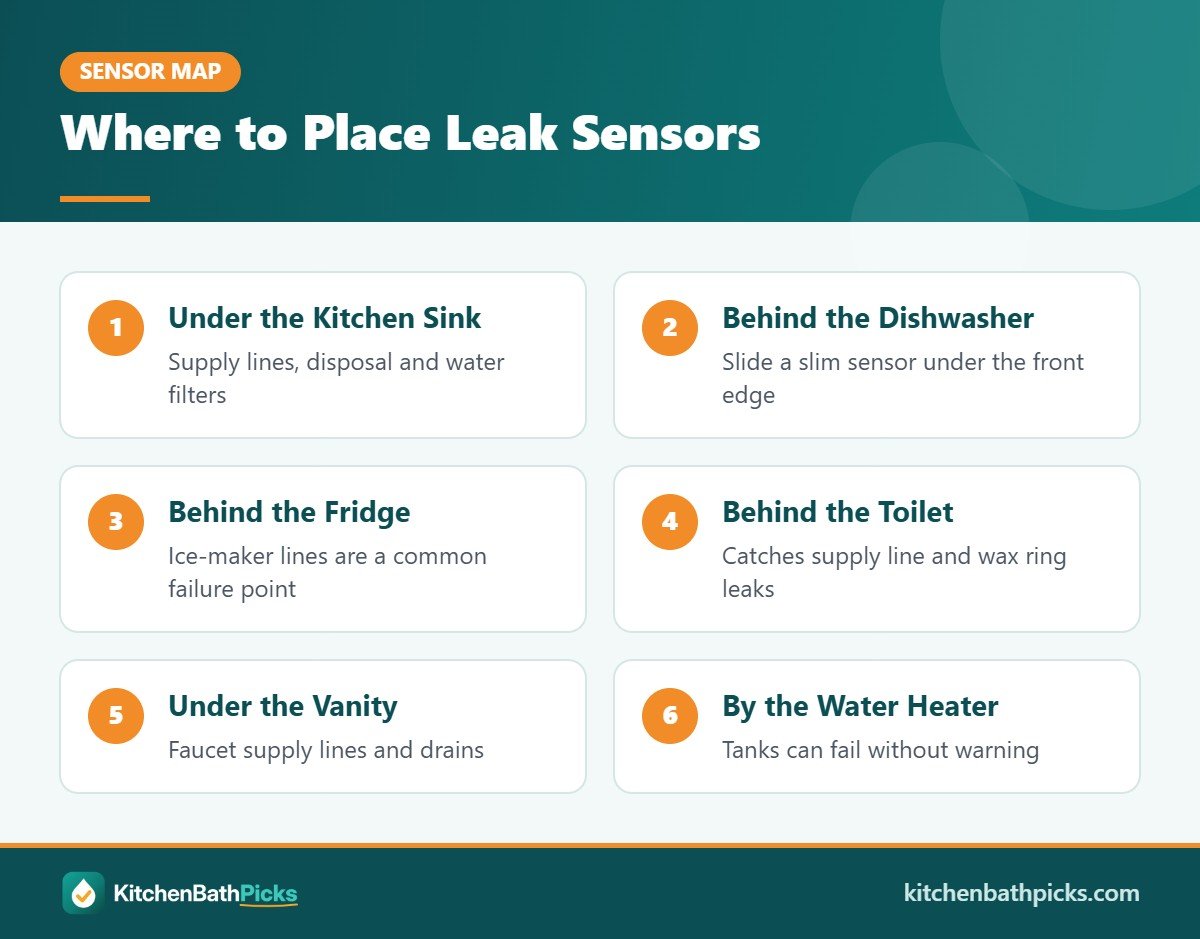
- Under the sink: supply lines, the faucet, the garbage disposal and any water filter all live here. If you have an organized under-sink cabinet, leave a clear spot on the cabinet floor for the sensor.
- Behind or beside the dishwasher: slide a slim sensor under the front edge or along the side.
- Behind the refrigerator: ice-maker and water-dispenser lines are notorious for failing, especially thin plastic tubing.
- Near any undercounter appliance with a water line: beverage centers, instant hot water units and coffee makers with plumbed lines.
Where to Put Leak Sensors in the Bathroom
- Behind the toilet: near the supply line and the base, where wax ring failures show up.
- Under the vanity: faucet supply lines and drain connections.
- Next to the tub or shower: especially if there’s an access panel to the valve.
- Beside the water heater: if it’s in or near a bathroom, closet or utility room.
Laundry rooms and basements are worth covering too, especially near the washing machine, sump pump and main water entry. Place a smart water leak detector at each of these spots for full coverage. Bathrooms usually need one smart water leak detector per fixture.
Choosing a System
Wi-Fi or hub-based?
Wi-Fi sensors connect directly to your router, so there’s nothing else to buy. But they can drain batteries faster and may struggle in basements with weak signal. Hub-based sensors use low-power radio protocols (such as Zigbee, Z-Wave, Thread or proprietary long-range radio) and often last longer and reach farther. If you already use a smart home hub, pick sensors that work with it.
Features worth paying for
- Loud local alarm in addition to phone alerts, in case the internet is down
- Temperature alerts to warn about freezing pipes in winter
- Humidity readings, which can also hint at hidden moisture problems
- Long battery life and low-battery warnings
- Integration with a shutoff valve, so a sensor can trigger the main valve
Shutoff valve considerations
Whole-home shutoff valves must match your main pipe size and material. Many require cutting into the main line, which is a plumber’s job. Some clamp onto an existing quarter-turn ball valve and rotate its handle with a motor, which is easier to install but only works if your existing valve is in good condition.
Also make sure the valve can be operated manually, has a battery backup or fails safely during power outages, and that you know how to override it if it closes by mistake.
Installation Tips That Prevent False Security
A leak protection system only works if it’s installed correctly. Insurance industry reports have described cases where a valve closed but water kept flowing through an open bypass loop, or where a valve installed outdoors in a box failed after flooding with mud. A smart water leak detector only helps if it is placed and tested correctly.
- Install valves indoors or in a protected, accessible location.
- Make sure there’s no bypass around the valve, or that it’s closed.
- Test the system after installation by triggering a sensor with a damp paper towel.
- Test monthly or at least seasonally, and replace sensor batteries on schedule.
- Exercise the valve occasionally (many systems do this automatically) so it doesn’t seize.
Pro Tip: Test it with a damp towel
The best way to see how smart leak detectors work in your own home is to test them: trigger each sensor with a damp paper towel and confirm the alert and valve respond.
Can Leak Detection Lower Your Insurance?
Many insurers offer discounts or credits for homes with water protection devices, especially automatic shutoff systems. Some partner with specific brands and offer discounted devices. Simple alarm-only sensors are less likely to earn a discount than systems that can actually stop the water. Ask your insurer whether a smart water leak detector or automatic shutoff valve qualifies for a discount.
Call your agent and ask directly whether they offer a premium discount for an automatic water shutoff system, which devices qualify and what proof they need. Even without a discount, preventing a single claim can protect your claims history and future premiums.
Pair Technology With Simple Maintenance
Sensors are a safety net, not a replacement for maintenance. Every year or two:
- Replace rubber appliance hoses with braided stainless steel lines.
- Check under sinks for dampness, corrosion or swollen cabinet floors.
- Inspect the toilet supply line and shutoff valve.
- Know where your main water shutoff is, and make sure everyone in the house can find it.
If a leak does happen, dry everything quickly. The EPA advises drying water-damaged materials within 24 to 48 hours to prevent mold. Our guide to common mold hiding spots shows where to look afterward.
A handful of sensors costs less than a single plumber’s visit. Add a shutoff valve, and you’ve turned one of the most common household disasters into a minor inconvenience. Once you understand how smart leak detectors work, a few well-placed sensors and a shutoff valve can turn a potential flood into a small puddle.
Smart Water Leak Detector FAQs
Where should I put water leak sensors?
Place them under kitchen and bathroom sinks, behind the dishwasher and refrigerator, behind toilets, next to the water heater and near the washing machine.
Do smart leak detectors stop leaks?
Spot sensors only alert you. To stop the water automatically, you need a motorized shutoff valve connected to the sensors or a whole-home flow monitoring system.
Can a water shutoff valve lower my homeowners insurance?
Many insurers offer discounts for automatic water shutoff systems. Alarm-only sensors are less likely to qualify. Ask your agent which devices are eligible.
Do I need a plumber to install an automatic shutoff valve?
Inline valves that cut into the main water line usually require a plumber. Clamp-on models that turn an existing ball valve are easier DIY installs.
How often should I test leak sensors?
Test them monthly or at least each season by touching the contacts with a damp cloth, and replace batteries when the app or device warns you.