
In this guide
The traditional shower valve hasn’t changed much in decades. You turn a handle, wait, adjust, wait again, and hope nobody flushes a toilet mid-shower. Digital shower systems replace that guesswork with a button or touchscreen that sets an exact temperature, remembers each person’s preferences and can even warm up the water before you step in. This guide explains how a digital shower system works, what it costs and whether one fits your bathroom. This guide explains how digital showers work and what to plan before you install one.
Industry surveys show smart showers are among the bathroom upgrades homeowners are most interested in. The National Kitchen and Bath Association’s 2026 bath research highlighted larger showers and smart fixtures as leading trends, as summarized in this report on 2026 bath trends. Here’s how digital showers actually work and what it takes to install one.
Key Takeaways
- ✓Here is how digital showers work: a wall controller sends your settings to a mixing valve hidden nearby.
- ✓The valve holds your chosen temperature, usually within about a degree.
- ✓Presets, warm-up mode and timers make showers easier and cut waste.
- ✓Installation is easiest during a remodel and needs power plus an accessible valve location.
How Digital Showers Work
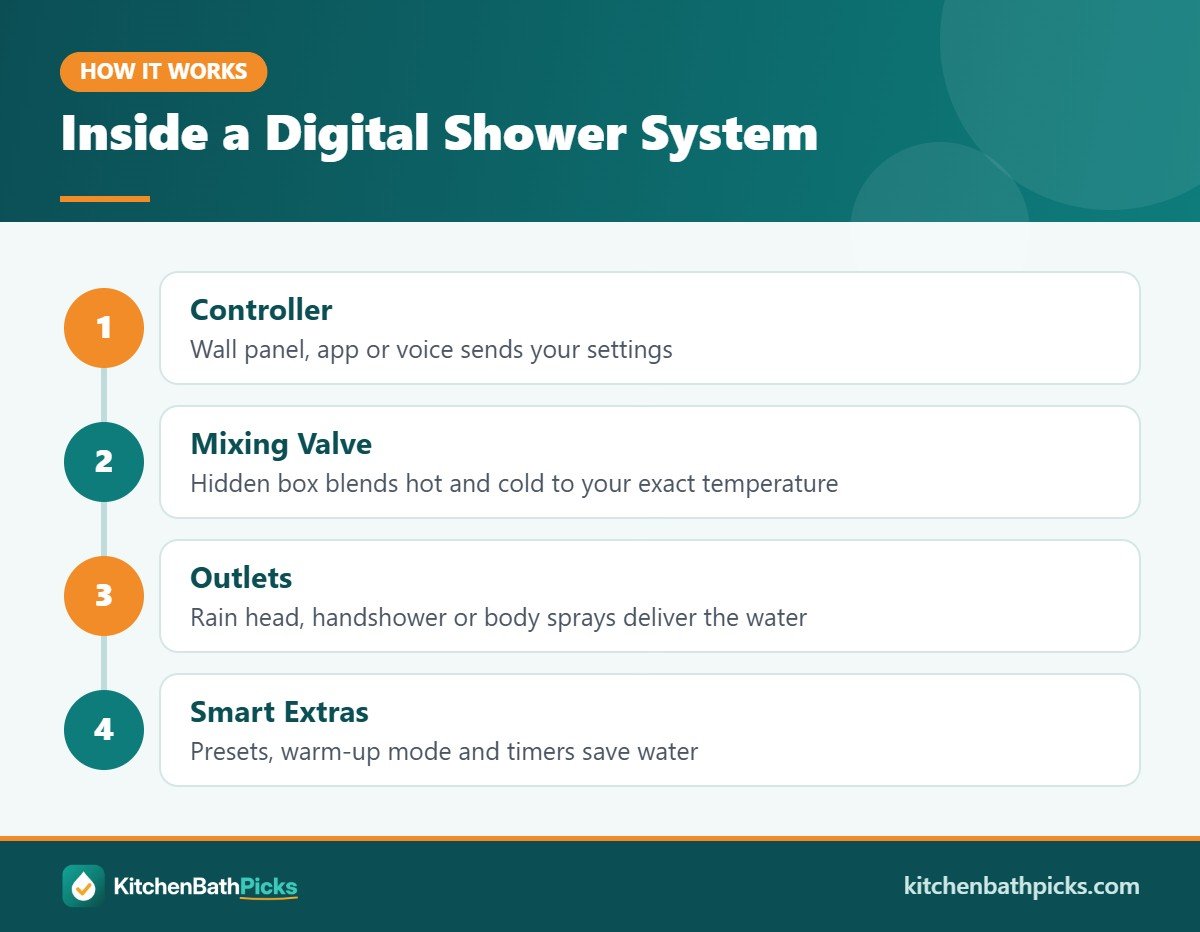
In a conventional shower, the valve sits in the wall directly behind the handle. Hot and cold water mix inside that valve, and your handle physically controls the mix. That is how digital showers work: the controller decides, the valve mixes and the outlets deliver.
A digital shower separates the controls from the mixing:
- The controller is a slim panel on the shower wall (or a remote, app or voice assistant). It sends commands electronically.
- The digital mixing valve is a box installed somewhere nearby, often in a ceiling, vanity, closet or wall cavity up to a specified distance from the shower. It contains motorized valves and temperature sensors.
- Outlets are the showerhead, handshower, body sprays or tub filler, connected to the valve by supply pipes.
The valve constantly measures water temperature and adjusts the hot and cold mix to hold your setting, usually within a degree or so. That’s a big step beyond the thermostatic valves we explained in our guide to how thermostatic shower valves work, although the principle of temperature compensation is similar.
6 Features That Make Digital Showers Appealing
Precise, stable temperature
Set 104°F and get 104°F, every time. The valve compensates for pressure changes elsewhere in the house, which also prevents sudden scalding or cold shocks.
User presets
Most systems store several profiles, each with a temperature, outlet choice and sometimes duration. One button gives each family member their ideal shower.
Warm-up mode
Many systems can run water until it reaches your temperature, then pause and alert you. You don’t waste water or stand outside the shower testing it with your hand.
Multiple outlets
Digital valves make it easy to switch between a rain head, handshower and body sprays, or run them together, with one control. Our guides to the best rain shower heads and best handheld shower heads cover outlets that pair well with these systems.
Timers and water tracking
Shower timers and usage displays help households cut water and energy use without thinking about it.
App and voice control
Start the shower from bed, set a timer or check usage. Handy, but treat this as a bonus rather than the main reason to buy.
Accessibility Benefits
Digital controls are a quiet win for aging in place and accessibility. Buttons are easier than stiff handles for people with arthritis. The control panel can be mounted at a seated height or near the shower entrance, so you can start the water without stepping into a cold spray. Fixed maximum temperatures add scald protection for children and older adults.
What Installation Involves
Power
The mixing valve needs electricity, usually from a nearby outlet or a hardwired connection. Low-voltage wiring runs from the valve to the controller in the shower, so the panel in the wet zone operates at safe voltage. Plan the power source with your electrician, and follow the manufacturer’s instructions for GFCI protection and placement. Every digital shower system has the same basic needs.
A home for the valve
The mixing box needs an accessible location for service, within the maximum distance specified by the manufacturer. Common spots include a vanity cabinet, a closet behind the shower wall, an attic above or a basement below. Avoid areas that can freeze.
Plumbing and water heater
Hot and cold supply lines run to the valve, and outlet lines run from the valve to each showerhead. Multiple outlets running at once can demand a lot of water, so check that your water heater and pipe sizes can keep up. A tankless heater must have enough flow capacity. Our tankless water heater guide explains flow rate sizing.
Network
For app control, the valve or controller needs a reliable Wi-Fi signal. Bathrooms can be dead zones, especially with tile walls. Check signal strength before installation.
Retrofit or Remodel?
Digital showers are easiest to install during a remodel, when walls are open. Some systems are designed for retrofits, with wireless controllers or valves that fit behind existing access panels, which reduces tile demolition. If you’re simply replacing a worn valve without remodeling, a standard thermostatic valve may be the more practical choice. Our guide to replacing a shower valve behind the wall covers that job.
Cost Considerations
Digital shower systems cost more than conventional valves, with professional installation adding to the total. Systems range from single-outlet setups to elaborate multi-head spa arrangements. We covered the broader price picture in our article on the cost of installing a smart shower. Budget for both the digital shower system itself and the installation.
To keep costs sensible:
- Choose the number of outlets you’ll actually use daily.
- Plan the valve location early so plumbing runs are short.
- Pick a system from a brand with local service support.
- Ask what happens during a power outage. Many systems default to closed, so you can’t shower without power.
Pro Tip: Ask about power outages
Part of how digital showers work is that many valves default to closed without power. Ask whether the system has a backup or manual option.
Water Efficiency
A digital valve doesn’t make a showerhead more efficient on its own, but timers and warm-up modes cut waste. For the biggest savings, pair the system with WaterSense labeled showerheads, which use no more than 2.0 gallons per minute. Be careful with multi-outlet designs: running a rain head and body sprays together can multiply water use quickly.
Is a Digital Shower Right for You?
A digital shower makes the most sense when you’re remodeling, when several people share a shower and like different temperatures, or when accessibility matters. It’s less compelling as a quick replacement for a working valve. If you choose one, plan the power, valve location, water supply and Wi-Fi as carefully as the tile. Get those right, and you’ll enjoy a perfectly tempered shower at the touch of a button for years. Once you understand how digital showers work, it’s easier to plan the valve location, power and outlets before a remodel.
Digital Shower System FAQs
What is a digital shower?
A digital shower uses an electronic mixing valve installed out of sight and a control panel in the shower to set exact water temperature and flow at the push of a button.
Does a digital shower need electricity?
Yes. The mixing valve needs power, and low-voltage wiring connects it to the controller. Many systems won’t run during a power outage.
Can I install a digital shower without removing tile?
Some retrofit-friendly systems use wireless controls and valves that fit behind access panels, which limits demolition. Full multi-outlet systems are easiest to install during a remodel.
Are digital showers safe for kids?
Yes. They hold a steady temperature and let you set a maximum temperature limit, which helps prevent scalding.
Do digital showers save water?
They can, through warm-up pauses, timers and usage tracking. Pair them with WaterSense showerheads and avoid running many outlets at once for the best savings.