In this guide
For many homeowners, the biggest obstacle to switching from gas to induction isn’t the stove. It’s the wall behind it. Gas ranges plug into an ordinary 120-volt outlet, while standard induction ranges need a heavy 240-volt circuit. In older homes, adding that circuit can mean opening walls, upgrading the electrical panel, or both. A battery induction range solves that problem in a clever way. Here is how battery induction ranges work, what they cost and which homes they suit best.
A new category of appliance sidesteps that problem entirely: the battery-equipped induction range. These stoves plug into the same 120V outlet your gas range uses, store energy in a built-in battery and release it when you cook. Here’s how they work, what they cost and whether one makes sense for your kitchen.
Key Takeaways
- ✓In short, here is how battery induction ranges work: a built-in battery charges slowly from a 120V outlet, then delivers high power when you cook.
- ✓Most homes need no 240V rewiring.
- ✓They can keep cooking during power outages.
- ✓Early models cost roughly $5,500 to $6,000 before incentives.
The Problem Battery Ranges Solve
A standard 120V, 15-amp outlet can safely deliver about 1,800 watts continuously. That’s enough for a microwave or a single portable induction burner, but nowhere near enough to run four induction zones and an oven at once. A full-size electric range can draw well over 10,000 watts at peak, which is why it needs a 240V circuit rated for 40 or 50 amps.
Upgrading wiring isn’t always simple. If your panel is full or your home has limited electrical service, the cost of a new circuit can be higher than the stove. We covered that decision in our guide to switching from gas to induction, where electrical work is often the deciding factor.
How Battery Induction Ranges Work
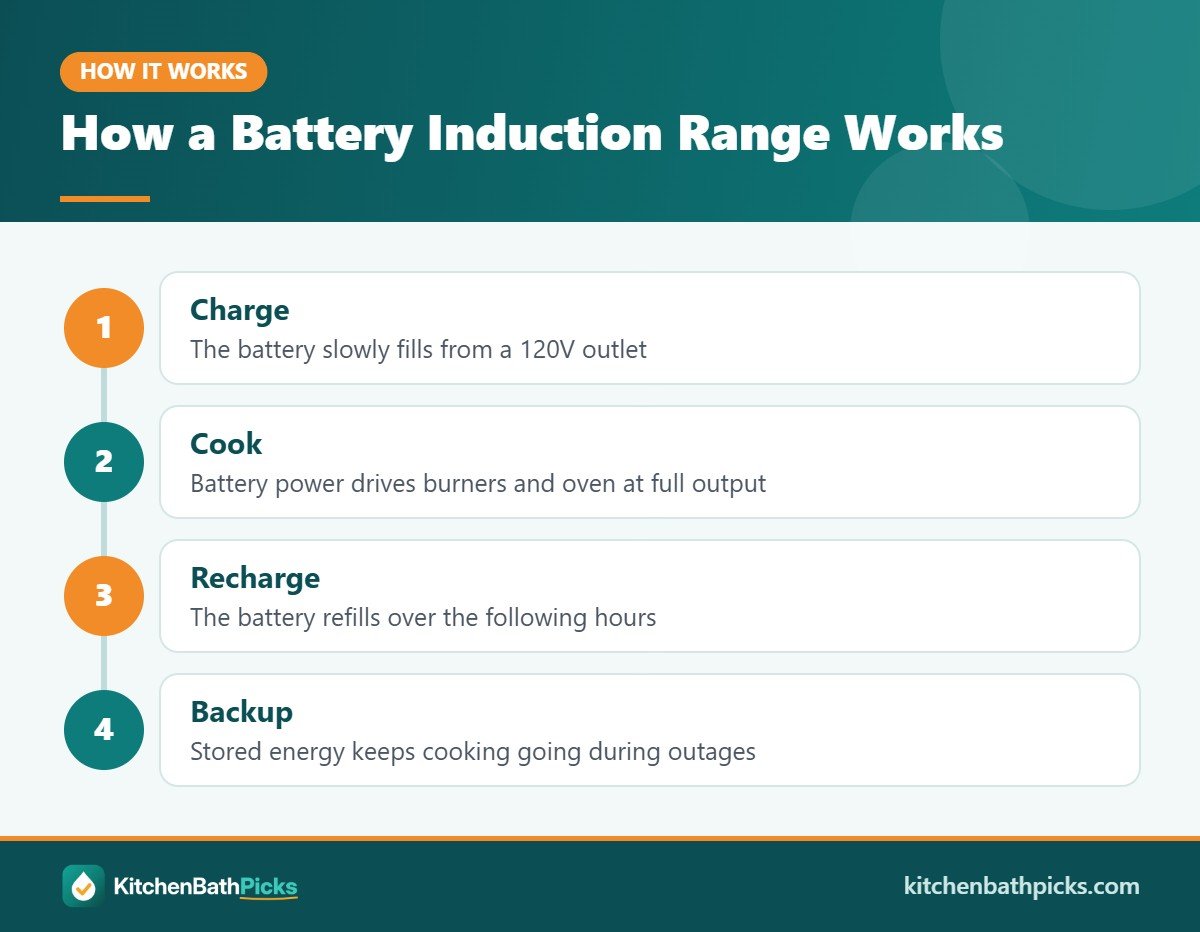
The concept is similar to a hybrid car. A battery-equipped range contains a lithium iron phosphate (LFP) battery pack, typically a few kilowatt-hours in size. Here’s the sequence: That is how battery induction ranges work in everyday cooking: the battery absorbs the power peaks so the outlet never has to.
- Charging: when you’re not cooking, the range slowly charges its battery from the 120V outlet.
- Cooking: when you turn on burners or the oven, the battery supplies the high power those elements need, topped up by power from the wall.
- Recharging: after cooking, the battery refills over the following hours.
Because the battery handles power peaks, the stove never asks the outlet for more than it can safely provide. Researchers at MIT described it as turning electrification into an appliance swap instead of a construction project, in this MIT Climate article on battery-powered appliances.
LFP batteries are a deliberate choice. They’re known for long cycle life and better thermal stability than some other lithium chemistries, which matters for something that lives in a hot kitchen.
Real Benefits
No rewiring in most homes
If there’s a working 120V outlet behind your current range, a battery model can usually plug straight in. Installation becomes a delivery, a gas line cap by a qualified professional, and setup. Here is what a battery induction range does well.
Cooking during power outages
Because the stove stores energy, it can keep cooking for a while when the grid goes down. That’s a genuine advantage over both standard electric ranges and many modern gas ranges, which may need electricity for igniters and oven controls. How long it lasts depends on what you cook and how full the battery was.
Strong cooking performance
The battery can deliver bursts of power that rival or exceed standard induction. Some makers advertise extremely fast boiling times for individual zones.
Potential energy flexibility
Some models can charge when electricity is cheapest, such as overnight on a time-of-use rate, and a few are designed to send stored energy back to the home or grid. These features depend on the model and your utility, so check carefully before counting on savings.
The Trade-Offs
- Price. Early models launched at roughly $5,500 to $6,000 before incentives, far more than a basic induction range. However, compare the total cost: range plus electrical work. If your home would need a panel upgrade, the gap shrinks or disappears.
- Weight and size. Batteries add weight. Check delivery requirements and floor clearance.
- Limited availability. Only a few companies make these stoves, so choices in style, size and service networks are narrower than conventional ranges.
- Heavy-use limits. Back-to-back marathon cooking sessions, like a holiday feast, can draw down the battery. Manufacturers design for typical home use, so ask about their worst-case scenarios.
- Battery lifespan. LFP batteries are durable, but they do age. Ask about warranty terms for the battery specifically.
Pro Tip: Check your outlet first
Because of how battery induction ranges work, a working 120V outlet behind your gas range is often all you need. Installation is usually delivery, a professional gas-line cap and setup.
Who Makes Them?
A handful of startups lead the category. Copper’s Charlie range is a full 30-inch range with an oven. Impulse Labs makes a battery-backed induction cooktop. Others are in development. Media coverage, including Canary Media’s reporting on battery induction stoves, has followed how these companies are targeting the tens of millions of US households that cook with gas. No battery induction range is perfect, and these are the compromises to weigh.
Housing authorities and apartment owners are early buyers, because avoiding electrical upgrades in hundreds of units saves enormous sums. That institutional demand should help bring more models and lower prices over time.
Is a Battery Induction Range Right for You?
It’s a strong candidate if:
- You want to leave gas but your electrical panel is full or undersized.
- Running a 240V circuit to the kitchen would be difficult or expensive.
- You live in an area with frequent power outages.
- You’re on a time-of-use electricity plan and want flexibility.
A standard induction range may be better if:
- You already have a 240V outlet behind the stove.
- Your panel has plenty of capacity and the circuit run is short.
- You want the widest choice of brands, sizes and finishes at lower prices.
Rebates and Incentives
Battery ranges are induction ranges, so they may qualify for the same incentives, including state-run HEAR rebates of up to $840 for income-qualified households replacing a gas range, plus utility rebates. Rules vary by state and program, and some require ENERGY STAR certification. Check with your state energy office and utility before buying. Check local programs before you switch to a battery induction range, since rules vary by state and utility.
Don’t Forget Cookware and Ventilation
Like any induction appliance, battery ranges need magnetic cookware. Our induction cookware guide shows how to test pans with a simple magnet. And while induction eliminates combustion pollutants, you’ll still want a range hood for steam, grease and smoke from searing.
Battery induction is still a young category, but it solves a real problem in a clever way. If rewiring has been the thing standing between you and induction, these plug-in ranges are worth a serious look. Now that you know how battery induction ranges work, you can judge whether one solves the wiring problem in your kitchen.
Battery Induction Range FAQs
Can an induction range plug into a regular outlet?
Standard induction ranges need a 240-volt circuit. Battery-equipped models are designed to plug into a standard 120-volt outlet and use stored battery power for high-heat cooking.
Do battery induction stoves work during a power outage?
Yes, for a limited time. The built-in battery can power cooking during an outage. Runtime depends on battery charge and how much you cook.
How much does a battery induction range cost?
Early models launched around $5,500 to $6,000 before incentives. Compare that with the cost of a standard range plus a new 240V circuit or panel upgrade.
What kind of battery do these stoves use?
Most use lithium iron phosphate (LFP) batteries, which are valued for long cycle life and good thermal stability.
Do battery induction ranges qualify for rebates?
They may qualify for state HEAR rebates and utility incentives for induction ranges. Eligibility varies, so confirm with your state program and utility.