In this guide
A few years ago, induction was something you saw in restaurant kitchens and European apartments. Now it sits on showroom floors next to the gas ranges, often at similar prices. If your gas stove is getting old, or you’ve read about indoor air pollution and want the flame out of your kitchen, you’re probably wondering what the switch really involves. Here is what switching from gas to induction really involves, step by step, so there are no surprises on installation day. If you are considering switching from gas to induction, the five steps below cover everything to check first.
The short answer is that the range itself is the easy part. The real questions are electrical: whether your kitchen has the right circuit, whether your panel can handle it, and what that work will cost. This guide walks through those questions in order, along with rebates, cookware and the learning curve.
Key Takeaways
- ✓Switching from gas to induction usually requires a dedicated 240V circuit, often 40 or 50 amps.
- ✓Get the electrician’s quote first, because wiring is the cost that varies most.
- ✓Income-qualified households may get up to $840 through state-run HEAR rebates.
- ✓Most cookware works if a magnet sticks firmly to the base.
How Induction Cooking Works
An induction cooktop has copper coils under a glass surface. When you turn on a zone, the coil creates a rapidly changing magnetic field. That field induces an electric current directly in the base of a magnetic pan, and the pan itself becomes the heat source. The glass only gets warm from contact with the hot pan. That speed and control are the main reasons people end up switching from gas to induction.
That design explains induction’s three big advantages:
- Speed. Energy goes straight into the pan, so a pot of water often boils noticeably faster than on gas.
- Control. Power changes instantly. Turn it down and the bubbling slows within seconds, much like gas.
- Cleaner air and a cooler kitchen. There’s no combustion, so no nitrogen dioxide or carbon monoxide. Less waste heat escapes into the room, too. Our guide to gas stove indoor air quality explains why that matters.
Spills are easier as well. Because the glass around the pan stays relatively cool, boil-overs rarely bake on.
Step 1: Check Your Electrical Setup
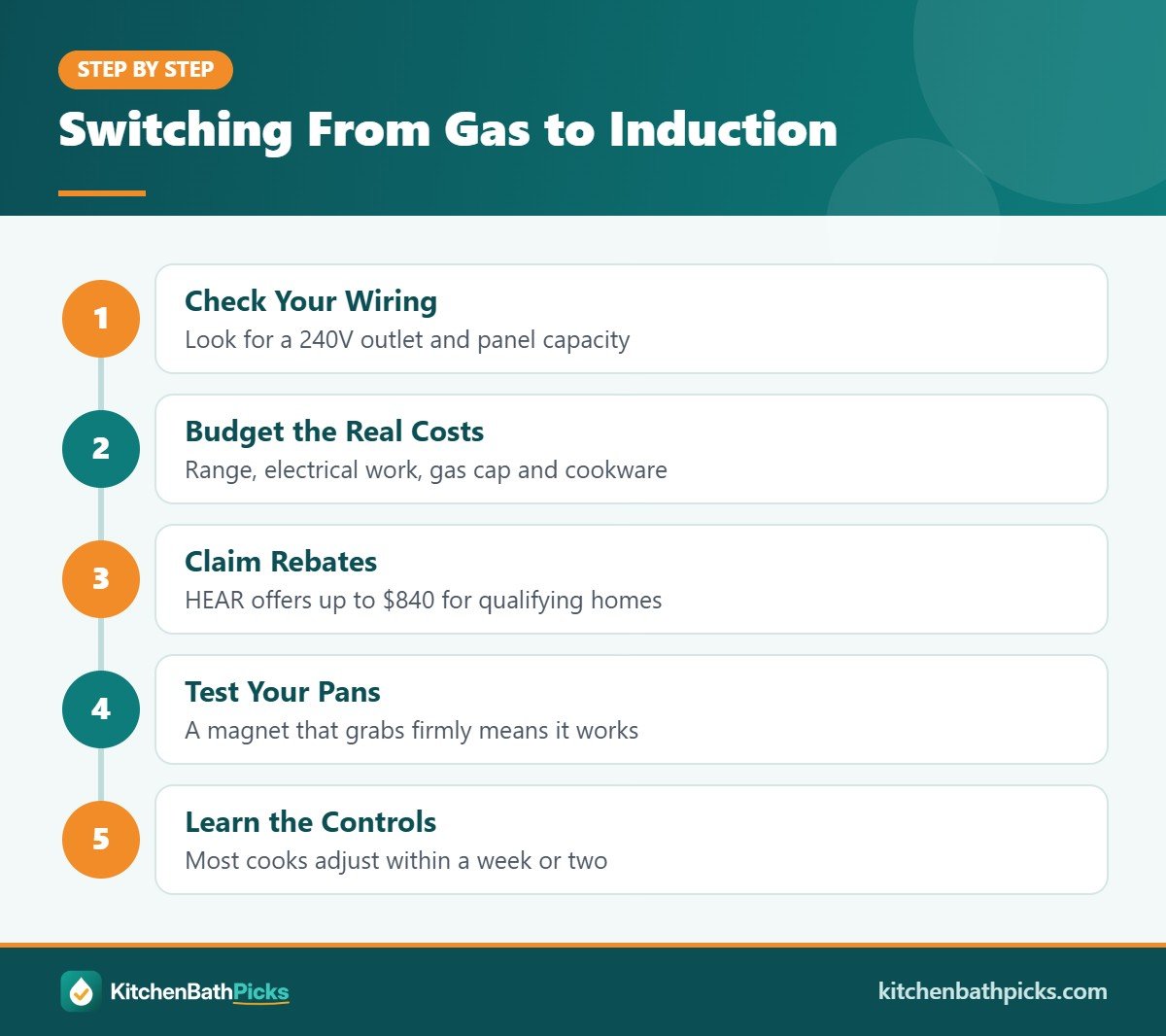
Almost every full-size induction range or cooktop needs a dedicated 240-volt circuit. A typical 30-inch range calls for a 40- or 50-amp circuit. Your gas range, by contrast, only needs a standard 120-volt outlet for its igniters, clock and oven light.
Open the cabinet or pull the range out and look at what’s behind it. You’ll fall into one of three situations:
- There’s already a 240V outlet. Some homes were wired for electric ranges and later converted to gas. If so, you may only need an electrician to confirm the circuit size and swap the receptacle.
- There’s no 240V circuit, but the panel has room. An electrician runs a new circuit from the panel to the range. Cost depends on distance, wall access and local labor rates. Expect a few hundred dollars for an easy run and more for long or finished-wall routes.
- The panel is full or undersized. Older homes with 60- or 100-amp service may need a load calculation, and possibly a panel or service upgrade. That’s the expensive scenario, and it’s worth getting a quote before you buy the range.
If option three sounds like you, don’t give up yet. Battery-equipped induction ranges that plug into a regular 120V outlet now exist. We’ll cover them in detail in an upcoming guide.
Also plan for the gas line. A licensed plumber or gas fitter should cap it properly behind the wall when the old range comes out.
Step 2: Understand the Real Costs of Switching From Gas to Induction
Here’s a rough way to budget a conversion:
- Induction range or cooktop: freestanding induction ranges start around the price of a mid-range gas model. Premium slide-ins and pro-style units cost more.
- Electrical work: from very little (existing 240V outlet) to a significant sum (new circuit plus panel upgrade).
- Gas line capping: usually a modest service call.
- Cookware: possibly nothing, possibly a few new pans (see Step 4).
- Countertop adjustments: cooktops sometimes need a cutout resized. Ranges usually drop into the same 30-inch opening.
Get the electrical quote first. It’s the number that decides whether this is a weekend swap or a bigger project.
Step 3: Look for Rebates
The federal Home Electrification and Appliance Rebates (HEAR) program, created by the Inflation Reduction Act, offers up to $840 toward an ENERGY STAR certified electric or induction stove, cooktop, range or oven. It also covers up to $2,500 for electrical wiring and up to $4,000 for a panel upgrade. The U.S. Department of Energy outlines the categories in its Home Energy Rebates fact sheet. Rebates can cover a big share of the cost of switching from gas to induction, so check them before you shop.
A few important caveats:
- HEAR rebates are for income-qualified households, generally at or below 150% of area median income.
- States run the programs, so availability, timing and rules vary. Some states have launched, others haven’t, and some programs stop once funding runs out.
- Many programs require that the new electric range replace a gas or propane appliance.
Even if you don’t qualify for HEAR, check your electric utility. Many utilities offer their own induction rebates, from small amounts to several hundred dollars, and some also lend out portable induction burners so customers can try the technology first.
Step 4: Check Your Cookware
Induction only works with magnetic cookware. The test is simple: if a fridge magnet sticks firmly to the bottom of the pan, it will work. Cast iron, enameled cast iron, carbon steel and most stainless steel pass. Plain aluminum, copper, glass and some stainless pans fail. Cookware is the line item people forget when switching from gas to induction.
Many people find most of their kitchen already works. Our best Dutch ovens picks, for example, are all induction-friendly because enameled cast iron is magnetic. If you’re replacing a set, our guide to the best stainless steel cookware covers sets with magnetic bases. We’ll go deeper on testing pans in our upcoming induction cookware guide.
Step 5: Expect a Short Learning Curve
Induction cooks happily within a week or two, but a few things feel different at first: For most cooks, the first week is the only awkward part of switching from gas to induction.
- It’s fast. Oil heats quickly. Have your ingredients prepped before the pan goes on.
- Numbers instead of flames. Most cooktops use power levels from 1 to 9 or a slider. You learn your “medium” by feel.
- Pans need contact. Tossing a pan in the air pauses heating. Most cooks learn to slide and stir instead.
- Some hum or click. A faint buzz at high power is normal, especially with lightweight pans.
- Wok cooking changes. Round-bottom woks don’t work on flat glass. Flat-bottom carbon steel woks do.
If you’re unsure, a portable induction burner is an inexpensive trial. Cook on it for a month before committing to a range.
Pro Tip: Try before you commit
A portable induction burner is an inexpensive way to test-drive induction cooking with your own pans before you replace the whole range.
Is Switching From Gas to Induction Worth It?
Induction makes the most sense when your gas range is near the end of its life, you’re remodeling, or someone in the house has asthma. It’s harder to justify if you need a panel upgrade and don’t qualify for rebates. Even then, the battery-equipped models are worth a look.
Whatever you decide, don’t let an old range fail on you before you’ve done the homework. Get an electrician’s opinion now, check your state’s rebate program, and test your pans with a magnet. When the day comes, you’ll know exactly what the switch will cost.
Switching From Gas to Induction: FAQs
Do I need a new circuit when switching from gas to induction?
Most full-size induction ranges need a dedicated 240-volt, 40- or 50-amp circuit. Gas ranges only use a 120-volt outlet, so many kitchens need new wiring unless they were previously electric.
How much is the federal induction rebate?
The HEAR program offers up to $840 for an ENERGY STAR electric or induction range for income-qualified households. States run the program, so check your state energy office for availability.
Will my pots work on induction?
If a magnet sticks firmly to the base, the pan will work. Cast iron, carbon steel, enameled cast iron and most stainless steel are compatible; aluminum, copper and glass usually are not.
Is induction faster than gas?
Usually, yes. Induction heats the pan directly, so it often boils water faster than gas and responds instantly when you change the power level.
Do I still need a range hood with induction?
Yes. Induction removes combustion pollutants, but cooking still produces steam, grease and smoke. A hood keeps cabinets cleaner and the air fresher.