In this guide
- Why Induction Needs Magnetic Cookware
- How to Test Pans for Induction: The 10-Second Magnet Test
- Which Cookware Materials Work on Induction?
- Beyond the Magnet: What Makes a Pan Good on Induction
- Why Some Pans Buzz or Click
- Workarounds for Pans You Love
- Protecting Your Glass Cooktop
- Building an Induction-Ready Kitchen on a Budget
- Induction-Compatible Cookware FAQs
The first question almost everyone asks after deciding on an induction cooktop is, “Do I have to replace all my pans?” Usually the answer is no. Most kitchens already own a good share of induction-ready cookware, and the pans that don’t work are easy to spot in about ten seconds with a fridge magnet. This guide shows how to confirm which pieces count as induction-compatible cookware and what to look for when you replace the rest. Below, you will learn how to test pans for induction in seconds and what to look for if a few pieces need replacing.
This guide explains why induction is picky about cookware, how to test what you own, which materials work best, and how to shop smart if you do need a few new pieces.
Key Takeaways
- ✓The quickest way to test pans for induction is a fridge magnet: if it grabs the center of the base firmly, the pan works.
- ✓Cast iron, carbon steel and magnetic clad stainless all work great.
- ✓Plain aluminum, copper, glass and ceramic won’t work without a steel base.
- ✓Four pieces cover most cooking: a skillet, a saucepan, a Dutch oven and a nonstick pan.
Why Induction Needs Magnetic Cookware
An induction cooktop doesn’t heat the glass. It creates a rapidly changing magnetic field that induces electric current in the bottom of the pan, and that current produces heat inside the metal. For that to happen efficiently, the pan base needs to contain a ferromagnetic metal, meaning iron or a magnetic grade of steel. According to ENERGY STAR, induction transfers about 85% of its energy into compatible cookware, compared with roughly 32% for gas.
Put a non-magnetic pan on the cooktop and most models simply won’t turn on, or they’ll flash an error. Nothing is damaged. The cooktop just can’t find anything to heat. If you’re still deciding whether to switch, our guide to switching from gas to induction covers costs, wiring and rebates.
How to Test Pans for Induction: The 10-Second Magnet Test
- Grab a fridge magnet. A strong, flat one works best.
- Hold it against the center of the pan’s underside.
- If it grabs firmly, the pan will work well. If it barely clings or slides off, it may heat weakly or not at all. If it doesn’t stick, the pan won’t work.
Test the center, not just the rim. Some pans have a magnetic disc only in the middle of the base, which is fine as long as the disc covers most of the bottom. This is the simplest way to test pans for induction, and it takes seconds.
You can also look for the induction symbol on the bottom, which looks like a coil or a zigzag line. But the magnet test is more reliable than labels, especially for older cookware.
Which Cookware Materials Work on Induction?
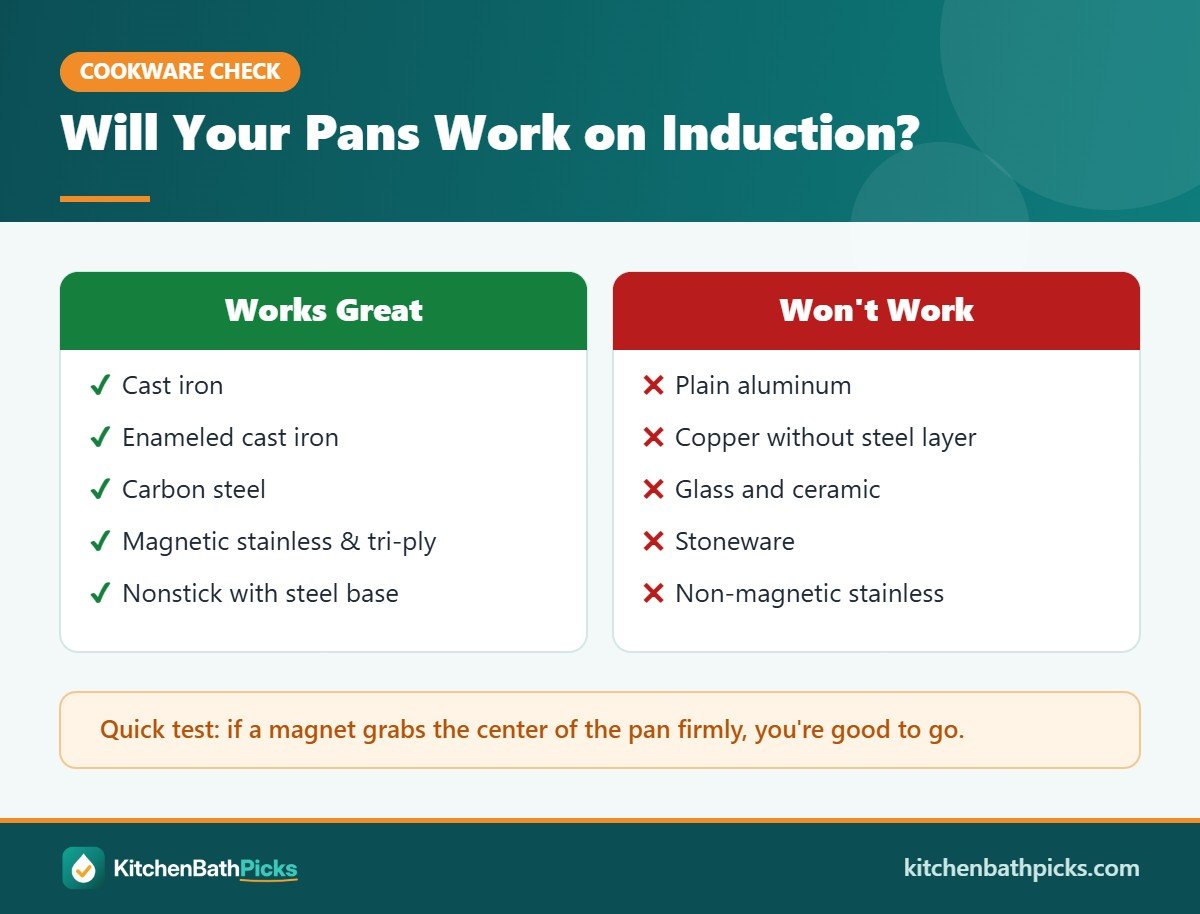
Works great
- Cast iron: naturally magnetic and excellent at holding heat. Lift it rather than slide it, because rough bottoms can scratch glass.
- Enameled cast iron: Dutch ovens and braisers work beautifully. See our best Dutch ovens for picks.
- Carbon steel: lighter than cast iron, very responsive and a favorite for searing and flat-bottom woks.
- Magnetic stainless steel and tri-ply: most quality clad stainless sets use a magnetic stainless exterior layer. Our best stainless steel cookware guide covers several.
Works if the base is designed for it
- Aluminum nonstick with a steel plate: many modern nonstick pans bond a magnetic steel disc to the bottom. Check with a magnet. Our best nonstick fry pan roundup notes induction compatibility.
- Copper with a steel layer: some premium copper lines add a magnetic stainless base for induction.
Won’t work
- Plain aluminum and anodized aluminum without a steel base
- Copper without a magnetic layer
- Glass, ceramic and stoneware
- Some lower-grade or older stainless steel (non-magnetic grades)
Ceramic-coated cookware is a special case. The coating doesn’t matter; the metal underneath does. Many ceramic nonstick pans have aluminum bodies, so test them. Our guide to the best ceramic cookware includes induction-ready options.
Beyond the Magnet: What Makes a Pan Good on Induction
A flat base
Induction works best when the pan sits flat against the glass. Warped pans heat unevenly and may rattle. Place a ruler across the bottom of the pan. If you can see light under the middle, the pan may not perform well.
The right size
Each cooking zone has a minimum pan size, often about 4 to 5 inches across, below which it won’t detect the pan. Very small pans like butter warmers or espresso pots may not register. Match pans to zones for the most even heating. Some cooktops have bridge zones that combine two coils for griddles.
A thick, fully clad base
The magnetic layer heats, and the layers above it spread that heat. Fully clad tri-ply or 5-ply pans distribute heat evenly up the sides. Thin disc-bottom pans heat fast in the center but can leave hot spots, especially in wide skillets.
Why Some Pans Buzz or Click
A faint hum or buzz at high power is normal, especially with multi-layer pans. The magnetic field makes the layers vibrate slightly. Clicking at low settings usually comes from the cooktop pulsing power on and off to hold a low temperature. Heavier pans with solid, flat bases tend to be quieter. Lightweight pans and pans with loose handles rattle more. A little hum is normal, even with high-quality induction-compatible cookware.
Workarounds for Pans You Love
If you have a beloved copper saucier or an aluminum pan you don’t want to give up, an induction interface disc can help. It’s a flat steel plate that sits on the cooktop, heats up by induction, and passes that heat to any pan on top. It works, but it’s slower and less efficient, and it removes induction’s fast response. Think of it as a backup for occasional use, not a daily solution.
For woks, the fix is a flat-bottom carbon steel wok. Some manufacturers also make concave induction wok burners, but those are specialty items.
Protecting Your Glass Cooktop
- Lift heavy pans rather than dragging them, especially cast iron.
- Keep pan bottoms clean. Burnt-on residue can scorch onto the glass.
- Don’t use the cooktop as a cutting surface or a place to set hot lids with rough rims.
- Use a cooktop cleaner made for glass ceramic surfaces and a soft cloth.
- A sheet of silicone or parchment under the pan can catch splatters. Check your cooktop manual first.
Pro Tip: Lift, don’t slide
Once you test pans for induction and find the keepers, protect your cooktop: lift heavy cast iron instead of sliding it, and keep pan bottoms clean.
Building an Induction-Ready Kitchen on a Budget
You don’t need to buy a full matched set. Start with what you use most:
- A 10- or 12-inch skillet (cast iron, carbon steel or tri-ply)
- A 3-quart saucepan with a magnetic base
- A large Dutch oven or stockpot for soups and pasta
- One induction-ready nonstick pan for eggs
Those four pieces cover the vast majority of home cooking. Test everything else you own with a magnet, keep what passes, and fill gaps slowly. Cast iron skillets in particular are inexpensive, last forever and perform superbly on induction.
The good news is that induction rewards quality cookware without demanding exotic gear. A magnet, a flat base and the right size are really all it asks for. Now that you know how to test pans for induction, you can check every pan you own before deciding whether anything needs replacing.
Induction-Compatible Cookware FAQs
How do I know if my pan works on induction?
Hold a magnet to the center of the pan’s base. If it sticks firmly, the pan will work. If it doesn’t stick, the pan isn’t induction compatible.
Does cast iron work on induction?
Yes. Bare and enameled cast iron are naturally magnetic and work very well. Lift cast iron instead of sliding it to avoid scratching the glass.
Why does my pan buzz on induction?
Buzzing comes from layers of metal vibrating in the magnetic field, usually at high power. It’s normal and harmless. Heavier, fully clad pans are typically quieter.
Can I use aluminum pans on induction?
Only if they have a bonded magnetic steel base. Plain aluminum won’t heat. An induction interface disc can work as a slower backup.
Do induction pans work on gas and electric stoves too?
Yes. Induction-compatible cookware works on gas, electric coil and radiant glass cooktops, so new pans won’t limit you later.