
In this guide
- What a Gas Stove Puts Into Your Kitchen Air
- Signs of Poor Gas Stove Indoor Air Quality
- Range Hoods: Ducted vs. Recirculating
- Free Fixes for Gas Stove Indoor Air Quality
- Makeup Air: The Part Most Kitchens Miss
- Monitoring Gas Stove Indoor Air Quality
- Is It Time to Consider Induction?
- Gas Stove Indoor Air Quality FAQs
Most people judge kitchen air by smell. If nothing is burning and the onions are behaving, the air must be fine. The trouble with a gas stove is that its main pollutant has no smell at all. Every time a burner lights, the flame produces nitrogen dioxide, and it does that whether you are searing a steak or just boiling water for tea. This guide explains gas stove indoor air quality in plain terms: what the burners release, how to tell when ventilation is falling short, and which fixes are worth your money. This guide explains what affects gas stove indoor air quality and the simple steps that make the biggest difference.
You don’t have to rip out your range to deal with it. Good ventilation habits, and a hood that actually moves air outdoors, make a measurable difference. This guide explains what a gas stove adds to your indoor air, how to tell whether your current setup is working, and the simple changes that give you the biggest improvement for the least money.
Key Takeaways
- ✓Gas stove indoor air quality suffers because burners release nitrogen dioxide, carbon monoxide, fine particles and moisture.
- ✓A ducted hood that vents outdoors beats a recirculating model for removing combustion pollutants.
- ✓Cook on the back burners and run the hood 10 to 15 minutes after you finish.
- ✓Hoods above about 400 CFM often need makeup air under local codes.
What a Gas Stove Puts Into Your Kitchen Air
Burning natural gas or propane produces heat, water vapor and carbon dioxide, plus smaller amounts of carbon monoxide and nitrogen dioxide (NO2). NO2 gets the most attention because it irritates the airways and is linked to asthma symptoms, especially in children. Understanding these pollutants is the first step toward better gas stove indoor air quality.
A large 2024 study from Stanford measured NO2 in more than 100 homes and found that typical gas or propane stove use raises a person’s long-term exposure by about 4 parts per billion. The researchers also found that levels in bedrooms could pass health benchmarks within an hour of cooking and stay elevated for hours. Their summary was blunt: it’s the fuel, not the food. You can read the findings in Stanford’s report on gas stove nitrogen dioxide.
Two details from that research matter for everyday life. First, the amount of gas you burn is the biggest factor, so long simmers and oven baking count as much as fast stir-fries. Second, smaller homes see higher concentrations from the same cooking, because there is less air to dilute the pollution.
Cooking itself also creates fine particles, grease aerosols and moisture. Those come from the food, so they matter even if you cook on electric or induction. Ventilation helps with all of them at once.
Signs of Poor Gas Stove Indoor Air Quality
Many kitchens have a hood that looks like it works but barely moves air. Watch for these clues: Any one of these signs suggests your gas stove indoor air quality needs attention.
- Windows fog up when you boil pasta, even with the fan on.
- Cooking smells reach the bedrooms or linger until the next morning.
- Grease film builds up on cabinet tops and the ceiling near the range.
- The smoke alarm goes off during ordinary searing.
- The hood is a microwave combo or a recirculating model with no duct to the outside.
A quick test: hold a square of tissue paper against the hood filter with the fan on high. If it doesn’t stick firmly, the fan isn’t pulling much air. Then go outside while the fan runs and check that the exterior vent flap actually opens. A stuck damper or a duct that ends in the attic defeats even a powerful motor.
Range Hoods: Ducted vs. Recirculating
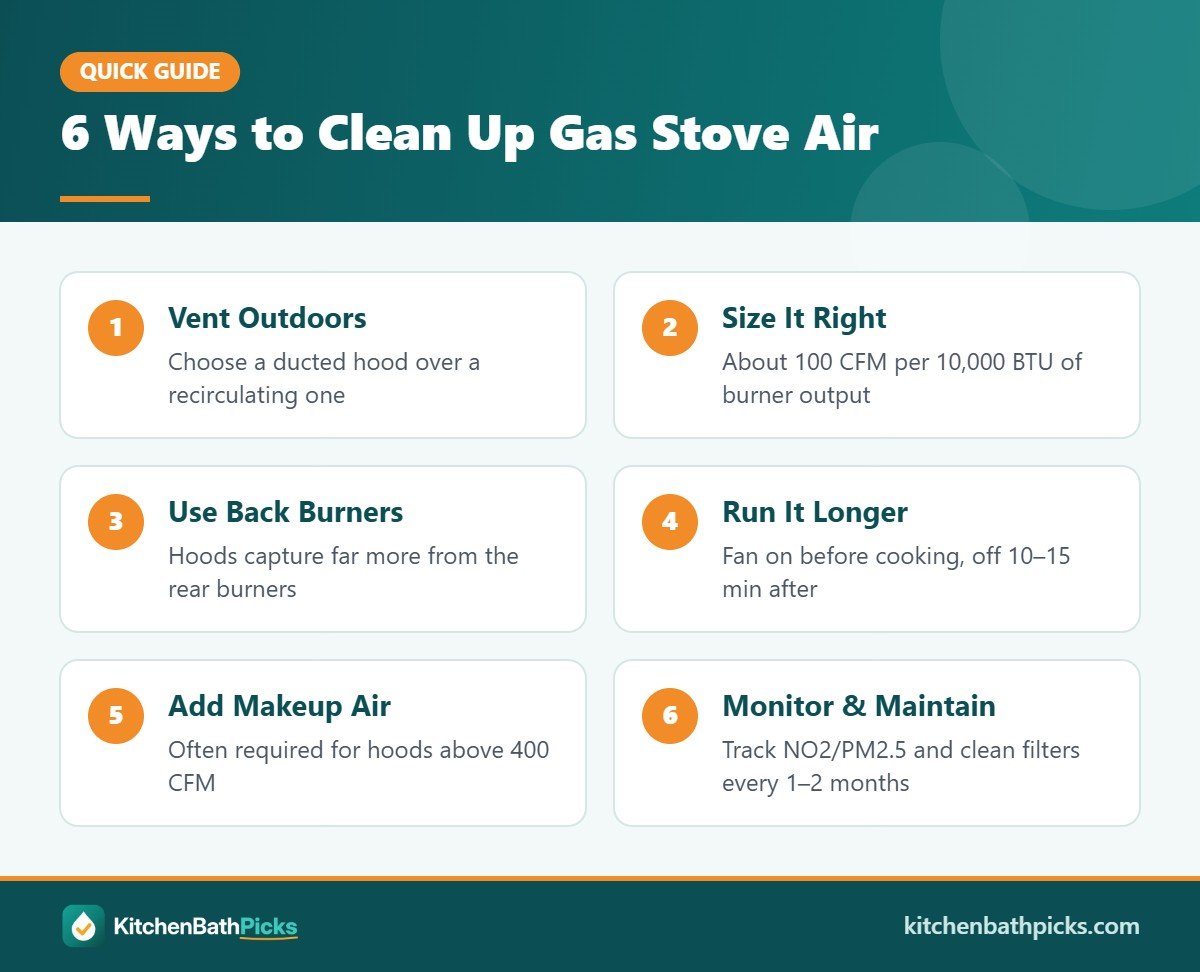
A ducted hood pulls air through a filter and pushes it outdoors. A recirculating (ductless) hood pulls air through a grease filter and usually a charcoal filter, then blows it back into the kitchen. Charcoal can reduce odors, but it does not remove nitrogen dioxide, carbon monoxide or moisture. For a gas range, a ducted hood is the only kind that deals with combustion pollutants. For gas stove indoor air quality, a ducted hood that vents outdoors is the biggest upgrade most kitchens can make.
If your home only allows a recirculating hood, run it anyway for grease and smells, then add another way to get air out. Stanford indoor-air researchers suggest using a nearby bathroom exhaust fan or opening a window in that situation, as explained in this Stanford Medicine interview on range hood use.
How much airflow (CFM) you need
Hood power is rated in cubic feet per minute (CFM). A common rule of thumb for gas ranges is 100 CFM for every 10,000 BTUs of total burner output. A typical 30-inch residential range with four burners totaling around 40,000 to 60,000 BTU lands in the 400 to 600 CFM range. Island hoods need more than wall hoods because there is no wall to channel the plume.
More CFM is not automatically better. Noise rises with airflow, and a hood you hate listening to is a hood you won’t use. Look at the sone rating at the speed you’ll use most. Around 1 to 3 sones on low is comfortable for everyday cooking.
Capture area matters as much as power
A hood can only catch what rises into it. Choose one at least as wide as your cooktop, and ideally 3 inches wider on each side. Deeper hoods that cover the front burners capture far more than shallow slide-out models. Mount it at the height the manufacturer specifies, usually 24 to 30 inches above a gas cooktop. Higher than that, and the plume escapes around the edges.
If you are shopping, our guide to the importance of a kitchen exhaust fan covers the basics of hood styles and placement.
Pro Tip: Try the tissue test
Hold a square of tissue paper against the hood filter with the fan on high. If it doesn’t stick firmly, your hood isn’t moving enough air to protect your kitchen.
Free Fixes for Gas Stove Indoor Air Quality
The cheapest improvement costs nothing. Cook on the back burners whenever you can. Rear burners sit closer to the hood’s capture zone, so more of the plume goes into the filter instead of drifting into the room. Researchers have found that a hood on low with a single back burner can capture roughly half to two-thirds of the pollutants.
Other habits that help:
- Turn the hood on before you light the burner and leave it running 10 to 15 minutes after you finish. Pollutant levels keep rising after the flame goes out.
- Use lids. Covered pots cook faster, so you burn less gas.
- Match the pan to the burner. Flames licking up the sides of a small pan waste energy and add pollution.
- Crack a window on the far side of the room when it’s practical, so fresh air replaces what the hood removes.
- Use small electric appliances for some jobs. An electric kettle, rice cooker or slow cooker keeps the flame off entirely.
- Never use the oven or stovetop to heat your home. That burns gas for hours with no ventilation.
Makeup Air: The Part Most Kitchens Miss
Every cubic foot of air your hood exhausts has to be replaced from somewhere. In a tight, modern house, a powerful hood can struggle because there’s no easy path for replacement air. It may also pull exhaust down a water heater or furnace flue, which is dangerous. Skip it, and even a powerful hood will do less for gas stove indoor air quality than its rating suggests.
Many building codes require a makeup air system for kitchen exhaust above 400 CFM. That’s usually a motorized damper that opens when the hood runs. If you’re upgrading to a bigger hood, ask your installer about local makeup air rules before you buy. A smaller hood with good capture often beats a huge one that can’t breathe.
Monitoring Gas Stove Indoor Air Quality
An indoor air monitor that reads NO2 or PM2.5 makes the invisible visible. Many households run the hood more consistently once they watch the numbers climb during dinner. Make sure you also have working carbon monoxide alarms on every level of the home, as with any combustion appliance. An affordable indoor air monitor takes the guesswork out of gas stove indoor air quality.
Clean metal mesh or baffle filters every month or two. Most go straight into the dishwasher. A clogged filter cuts airflow and becomes a fire hazard. Replace charcoal filters in recirculating hoods on the schedule in the manual, usually every three to six months.
Finally, have the range checked if the flames look yellow or lazy instead of crisp and blue. Poor combustion produces more carbon monoxide and soot. This is the kind of small issue our guide to keeping small kitchen problems from becoming big ones recommends catching early.
Is It Time to Consider Induction?
If you’re replacing a range anyway, an induction cooktop removes combustion pollutants from the kitchen completely. You’ll still want a hood for grease, steam and cooking smoke, but you won’t be managing nitrogen dioxide. Induction also heats faster and keeps the kitchen cooler in summer. We’ll cover costs, rebates and wiring in our upcoming guide to switching from gas to induction. Switching fuels is the most complete fix for gas stove indoor air quality, though better ventilation gets you most of the way there.
Until then, the formula is simple. Use a ducted hood if you can, size it sensibly, cook on the back burners and keep the fan running a little longer than feels necessary. Those habits protect everyone in the house, not just the cook.
Gas Stove Indoor Air Quality FAQs
Does a gas stove pollute the air even when I’m not burning food?
Yes. The flame itself creates nitrogen dioxide and small amounts of carbon monoxide. Boiling water on a gas burner produces these pollutants just as frying does.
Is a recirculating range hood enough for a gas stove?
No. Recirculating hoods filter grease and some odors but return combustion gases and moisture to the room. Pair one with a window or another exhaust fan, or upgrade to a ducted hood.
How long should I run the range hood after cooking?
Keep it running 10 to 15 minutes after you turn off the burners. Pollutant levels peak after cooking ends, and the extra time clears what lingers.
What CFM range hood do I need for a gas range?
A common guideline is 100 CFM per 10,000 BTUs of burner output, which puts most 30-inch gas ranges between 400 and 600 CFM. Hood width, depth and mounting height matter as much as the number.
Why should I cook on the back burners?
Back burners sit directly under the hood’s strongest capture zone, so more smoke, steam and gas exhaust goes into the filter instead of spreading through your home.