In this guide
- What Are PFAS, and How Do They Get in Tap Water?
- Where Federal PFAS Drinking Water Rules Stand
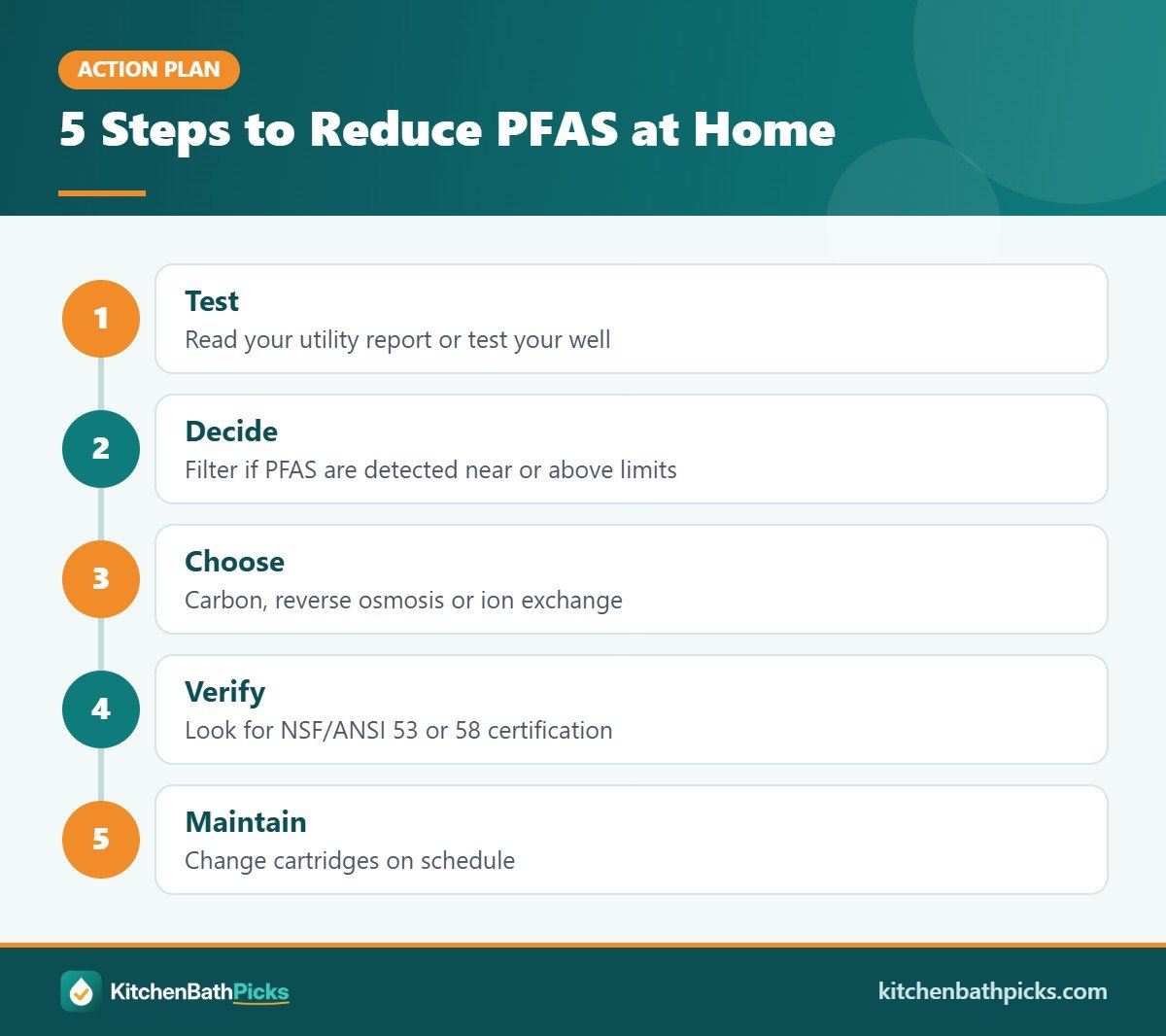
- Step 1: Check for PFAS in Tap Water at Home
- Step 2: Decide Whether You Need a Filter
- Step 3: Choose the Right Type of Filter
- Step 4: Check for Certification
- Step 5: Maintain It Religiously
- Other Ways to Reduce PFAS Exposure
- PFAS in Tap Water FAQs
PFAS, often called “forever chemicals,” have gone from obscure lab acronyms to dinner-table conversation. They show up in news stories about drinking water, nonstick pans, rain jackets and even food packaging. If you’ve read that headlines say federal rules are changing, you may be wondering whether your tap water is safe and whether you need a filter. This guide walks through what PFAS in tap water means for your home and what you can do about it today. Here is what PFAS in tap water means for your household and the practical steps you can take.
This guide explains what PFAS are, where the federal drinking water rules stand, how to find out what’s in your water and which home filters can help.
Key Takeaways
- ✓In 2024 the EPA set limits of 4 parts per trillion for PFOA and PFOS in tap water.
- ✓In May 2026 the EPA proposed rescinding limits for other PFAS and extending some deadlines.
- ✓Check your utility’s water quality report, or test a private well.
- ✓Carbon, reverse osmosis and ion exchange filters can reduce PFAS when certified.
What Are PFAS, and How Do They Get in Tap Water?
Per- and polyfluoroalkyl substances (PFAS) are a large family of manufactured chemicals used since the 1940s for their resistance to heat, water, oil and stains. Their chemical bonds are extremely strong, so they break down very slowly in the environment and can build up in people and animals over time. That persistence is where the “forever chemicals” nickname comes from.
PFAS can reach drinking water sources from industrial sites, firefighting foam used at airports and military bases, landfills and wastewater. Scientific studies have linked exposure to certain PFAS with health effects, which is why regulators have focused on drinking water.
Where Federal PFAS Drinking Water Rules Stand
In April 2024, the EPA finalized the first national, enforceable drinking water limits for six PFAS. The limits for the two best-studied compounds, PFOA and PFOS, were set at 4.0 parts per trillion each. The rule also set limits for PFHxS, PFNA and HFPO-DA (GenX chemicals), plus a “hazard index” for mixtures. Water systems were given until 2027 to finish initial monitoring and until 2029 to fix problems. The EPA’s PFAS drinking water regulation page summarizes the rule. These rules decide how much PFAS in tap water utilities must remove.
In May 2026, the EPA proposed two major changes:
- Keep the PFOA and PFOS limits at 4 parts per trillion, but allow qualifying water systems to request two extra years, until 2031, to comply.
- Rescind the limits for PFHxS, PFNA, HFPO-DA and the mixture hazard index, with the agency saying it would revisit those compounds through a new process.
The public comment period ran through July 2026. Because these were proposals, check the EPA’s page for the final status before relying on any specific deadline. Some states also set their own PFAS standards, which may be stricter than the federal ones, so state rules matter too.
What this means for you: your utility’s timeline for removing PFAS may stretch out, and fewer PFAS compounds may be federally regulated. If you’re concerned about your exposure, a certified home filter is something you can control right now.
Step 1: Check for PFAS in Tap Water at Home
If you’re on city water
Start with your utility’s annual water quality report, sometimes called a Consumer Confidence Report. Under the 2024 rule, systems must begin including PFAS monitoring results by 2027, and many already publish data. You can also call your utility and ask whether they test for PFAS, what levels they’ve found and what they plan to do.
Many utilities also participated in EPA’s national PFAS monitoring program, so data may exist for your system even if it isn’t in the annual report yet.
If you have a private well
Private wells serving individual homes aren’t regulated under the federal Safe Drinking Water Act. You’re responsible for testing. The EPA recommends using a state-certified laboratory that uses EPA-developed testing methods, and contacting your state health or environmental agency for advice. See the EPA’s guidance on PFAS in private wells.
Step 2: Decide Whether You Need a Filter
If PFAS haven’t been detected in your water, or levels are well below federal limits, a PFAS filter may not be necessary. The EPA itself notes this. If PFAS have been found, levels are unknown, or you simply want extra peace of mind, a filter is a reasonable step. If testing shows PFAS in tap water above the levels you are comfortable with, a filter is the fastest fix.
Pay special attention if anyone in your home is pregnant, breastfeeding or preparing infant formula, since early life stages can be more sensitive.
Step 3: Choose the Right Type of Filter
The EPA identifies three filtration technologies that can be effective at reducing PFAS: Not every filter removes PFAS in tap water, so the technology matters.
Activated carbon (granular or carbon block)
Carbon traps chemicals as water passes through. Carbon is used in pitcher filters, faucet-mount filters, refrigerator filters and under-sink systems. Quality varies widely, so certification matters. EPA research suggests carbon can effectively remove many, though not all, PFAS compounds.
Reverse osmosis (RO)
RO forces water through an extremely fine membrane that blocks a wide range of contaminants, including PFAS. RO systems usually install under the kitchen sink and include carbon pre-filters. They’re among the most effective options but produce wastewater, need a dedicated faucet and take up cabinet space.
Ion exchange resins
Specialized resins attract and hold contaminants. They’re more common in whole-house and utility-scale systems than in everyday kitchen filters.
Where to install
- Pitcher filters: lowest cost and easy for renters, but slow and small.
- Faucet-mount filters: convenient for drinking and cooking water. See our best faucet water filter guide.
- Under-sink carbon or RO: the best balance of performance and convenience for most families. Our article on why you should install a kitchen water filter covers the basics, and our under-sink filter roundup arrives in December.
- Whole-house systems: treat every tap, but usually unnecessary for PFAS, since exposure comes mainly from drinking and cooking.
Step 4: Check for Certification
Don’t rely on vague claims like “removes chemicals.” Look for certification by an accredited third-party body. According to the EPA, you should check packaging for certification to NSF/ANSI 53 (common for carbon filters) or NSF/ANSI 58 (for reverse osmosis) for PFAS reduction, typically listed as PFOA and PFOS reduction. You can confirm by searching the certifier’s online product directory.
One caveat: the EPA has noted that filter certification standards were developed before the 4 ppt limits, so certification doesn’t necessarily mean a filter reduces PFAS to that level. Reducing levels still lowers exposure.
Step 5: Maintain It Religiously
A filter is only as good as its last cartridge change. Overdue carbon filters can become saturated and stop removing contaminants. Set phone reminders based on the manufacturer’s schedule or gallons filtered. Many under-sink systems now include indicator lights or apps that track filter life.
Pro Tip: Mind the cartridge date
A filter that’s past its replacement date can stop reducing PFAS. Set a phone reminder the day you install a new cartridge.
Other Ways to Reduce PFAS Exposure
Drinking water is only one source. The EPA’s list of practical steps to reduce PFAS risk includes checking local fish advisories and being aware of PFAS in consumer products. In the kitchen, many cooks are also choosing PFAS-free options such as stainless steel, cast iron and ceramic-coated pans. Our best ceramic cookware guide covers PFAS-free sets. Drinking water is only one source, so reducing PFAS in tap water is part of a bigger picture.
The regulatory picture may keep shifting, but the practical steps don’t change much: learn what’s in your water, filter if you need to, choose certified products and keep up with maintenance.
PFAS in Tap Water FAQs
What is the EPA limit for PFAS in drinking water?
The 2024 rule set enforceable limits of 4.0 parts per trillion for PFOA and PFOS. In May 2026 the EPA proposed keeping those limits while extending the compliance deadline to 2031 for qualifying systems and rescinding limits for four other PFAS. Check the EPA for final status.
Do water filters remove PFAS?
Activated carbon, reverse osmosis and ion exchange filters can reduce PFAS. Look for certification to NSF/ANSI 53 or 58 for PFOA and PFOS reduction.
Does boiling water remove PFAS?
No. Boiling does not remove PFAS and can slightly concentrate them as water evaporates. Use a certified filter instead.
How do I know if my water has PFAS?
Check your utility’s annual water quality report or call the utility. Private well owners should test with a state-certified laboratory using EPA methods.
Is reverse osmosis better than carbon for PFAS?
Reverse osmosis typically removes a broader range of PFAS, while quality certified carbon filters are effective for many compounds and cost less. Both need regular maintenance.