

Kitchen Bath Picks is reader-supported. When you buy through links on this page, we may earn an affiliate commission at no extra cost to you. Learn more.
In this guide
- Why you should clean your kitchen faucet regularly
- What you'll need to clean a kitchen faucet
- Know your finish before you clean
- How to clean kitchen faucet surfaces: daily and weekly
- How to remove hard water stains from a kitchen faucet
- How to clean a kitchen faucet aerator
- How to clean a pull-down sprayer head
- How to clean the kitchen faucet cartridge
- Products that help you clean a kitchen faucet
- Mistakes to avoid when cleaning a kitchen faucet
- How to keep your kitchen faucet clean longer
- How to clean kitchen faucet FAQs
- Final thoughts
Your kitchen faucet is one of the most-touched surfaces in the house. Raw chicken, dish soap, greasy fingers and hard water all leave their mark, and before long the finish looks dull, spotted and crusty around the base. Knowing how to clean a kitchen faucet properly keeps it hygienic, keeps the finish looking new and stops mineral buildup from clogging the aerator and wearing out the cartridge.
This 2026 guide covers how to clean kitchen faucet finishes safely, remove hard water deposits, deep clean the aerator, sprayer and cartridge, and keep the faucet clean with a few minutes of care each week.
Quick answer: Wipe the faucet with warm water and a drop of dish soap on a soft microfiber cloth, then rinse and dry it. For hard water spots, wrap the area in a cloth soaked in equal parts white vinegar and water for 15 to 30 minutes, then scrub gently with a soft toothbrush, rinse and dry. Avoid bleach, abrasive powders and scouring pads, which can damage the finish.
Why you should clean your kitchen faucet regularly
- Hygiene: handles and spray heads collect germs from raw food and dirty hands.
- Hard water: calcium and magnesium deposits leave white crust that can clog the aerator and spray nozzles.
- Finish protection: grime and minerals left too long can etch or discolor the finish.
- Performance: clean aerators and sprayers keep water pressure strong and the spray even.
- Longer life: less mineral buildup means less wear on cartridges and seals.
What you’ll need to clean a kitchen faucet
- Mild dish soap and warm water
- White vinegar (or a commercial lime scale remover)
- Baking soda for gentle scrubbing
- Soft microfiber cloths
- An old soft toothbrush and cotton swabs
- A plastic bag and rubber band (for soaking the spout or spray head)
- Rubber gloves
Know your finish before you clean
Different finishes need different care. When in doubt, check the manufacturer’s care instructions and test any cleaner on a hidden spot.
| Finish | Safe to use | Avoid |
|---|---|---|
| Chrome | Soap, diluted vinegar, glass cleaner | Abrasive pads, bleach |
| Stainless steel | Soap, stainless steel cleaner, vinegar | Steel wool, chlorine bleach |
| Brushed nickel | Soap and water, diluted vinegar briefly | Abrasives, harsh acids |
| Matte black | Soap and water only, soft cloth | Vinegar soaks, abrasives, polishes |
| Oil-rubbed or living bronze | Soap and water, dry thoroughly | Acids, abrasives, chemical cleaners |
| Brass and gold tones | Soap and water, manufacturer-approved polish | Acidic cleaners, abrasives |
How to clean kitchen faucet surfaces: daily and weekly
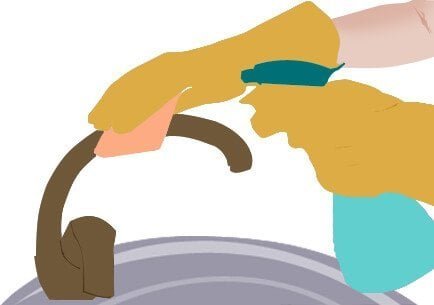
- Wet a microfiber cloth with warm water and a drop of dish soap.
- Wipe the spout, handle and base, working from top to bottom.
- Use a soft toothbrush around the base, handle joints and other crevices where grime collects.
- Rinse with a clean damp cloth to remove soap residue.
- Dry the faucet completely with a dry microfiber cloth to prevent water spots.
Drying is the step most people skip, and it’s the most effective way to prevent hard water spots between cleanings.
How to remove hard water stains from a kitchen faucet
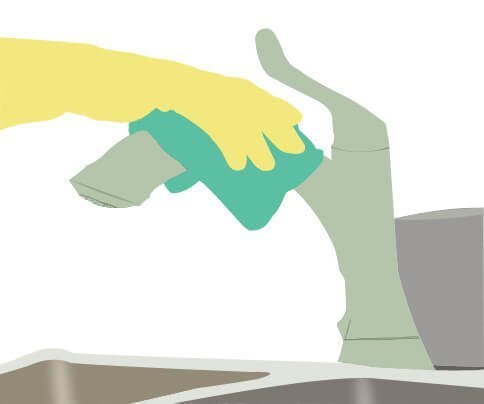
- Mix equal parts white vinegar and warm water.
- Soak a cloth or paper towel in the solution and wrap it around the stained area, especially the base and the spout tip.
- Leave it for 15 to 30 minutes (shorter for brushed nickel and other delicate finishes).
- Scrub gently with a soft toothbrush. For stubborn spots, make a paste of baking soda and a little water.
- Rinse thoroughly with clean water and dry completely.
Caution: Don’t use vinegar soaks on matte black, oil-rubbed bronze or other specialty finishes unless the manufacturer allows it. Never mix vinegar with bleach or other cleaners.
How to clean a kitchen faucet aerator
If your water stream has become weak, sputtering or uneven, the aerator at the tip of the spout is probably clogged with minerals or debris.
- Unscrew the aerator by hand, counterclockwise. If it’s stuck, wrap it in a cloth and use pliers gently.
- Take it apart over a towel and note the order of the screen, washer and insert.
- Rinse the parts under running water and brush away debris with a toothbrush.
- Soak the parts in white vinegar for 30 minutes to an hour to dissolve mineral buildup.
- Rinse, reassemble in the same order and screw the aerator back on.
For more detail, see our guide to unclogging a kitchen faucet aerator.
How to clean a pull-down sprayer head
Pull-down and pull-out spray heads have small nozzles that clog easily. Many have soft rubber nozzles you can rub with your finger to break off mineral deposits. For heavier buildup, fill a plastic bag with vinegar, place it over the spray head, secure it with a rubber band and leave it for 30 minutes to an hour (only if the finish allows it). Remove the bag, run water through the sprayer, and wipe it dry.
How to clean the kitchen faucet cartridge
If the handle feels stiff or the faucet drips, mineral deposits may be affecting the cartridge.
- Turn off the hot and cold water under the sink and open the faucet to release pressure.
- Cover the drain so small parts can’t fall in.
- Remove the handle cap and screw, then the handle.
- Unscrew the retaining nut or remove the clip and pull out the cartridge.
- Soak the cartridge in white vinegar to loosen deposits, scrub gently and rinse.
- Apply silicone faucet grease to the O-rings, reinstall the cartridge and reassemble.
- Turn the water back on slowly and check for leaks.
If the cartridge is cracked or the faucet still drips, replace it. See our single-handle cartridge faucet repair and kitchen faucet leaking guides.
Products that help you clean a kitchen faucet
1. Bar Keepers Friend Soft Cleanser
A gentle liquid cleanser for hard water spots and grime on chrome and stainless.
- Size13 oz
- TypeLiquid cleanser
- UseWater spots, soap scum
- Best onChrome, stainless steel
- BrandBar Keepers Friend
- FormPremixed
Pros
- Removes hard water spots
- Gentler than powder
- Versatile
Cons
- Test on brushed and specialty finishes first
- Rinse thoroughly
2. Weiman Stainless Steel Cleaner & Polish Spray
A spray that cleans and polishes stainless steel faucets and resists fingerprints.
- TypeSpray cleaner and polish
- IncludesMicrofiber cloth
- UseStainless steel
- FinishStreak-free shine
- BrandWeiman
- FeatureFingerprint resistant
Pros
- Leaves a polished finish
- Resists fingerprints
- Includes a cloth
Cons
- For stainless steel only
- Not for matte or bronze finishes
3. CLR Pro Calcium, Lime & Rust Remover
A powerful descaler for heavy limescale on aerators and chrome fixtures.
- Size1 gallon
- TypeDescaler
- UseCalcium, lime, rust
- DilutePer label
- BrandCLR
- Best onChrome fixtures, aerators
Pros
- Dissolves heavy buildup fast
- Large supply
- Works on aerator parts
Cons
- Not for many specialty finishes; check the label
- Use gloves and ventilation
4. MR.SIGA Microfiber Cleaning Cloths, 12 Pack
Soft microfiber cloths for streak-free cleaning and drying.
- Pack12 cloths
- MaterialMicrofiber
- UseCleaning and drying
- FinishStreak-free
- BrandMR.SIGA
- WashableYes
Pros
- Safe on every finish
- Streak-free drying
- Reusable
Cons
- Wash separately from lint-producing fabrics
- Avoid fabric softener
Mistakes to avoid when cleaning a kitchen faucet
- Using bleach, ammonia or chlorine cleaners, which can corrode finishes.
- Scrubbing with steel wool, scouring pads or abrasive powders.
- Leaving vinegar or descaler on too long.
- Spraying cleaner directly on the faucet so it drips into seams; spray the cloth instead.
- Forgetting to rinse and dry after cleaning.
How to keep your kitchen faucet clean longer
Wipe and dry the faucet after doing dishes, clean the aerator every few months and do a deeper clean monthly. If you have hard water, a water softener can dramatically reduce spotting and buildup. If the finish is badly damaged or the faucet keeps leaking, it may be time for a new faucet; see our best kitchen faucets guide and our step-by-step guide to replacing a kitchen faucet.
How to clean kitchen faucet FAQs
What is the best way to clean a kitchen faucet?
Wipe it with warm soapy water on a microfiber cloth, rinse and dry. For hard water deposits, use diluted white vinegar briefly, then rinse and dry.
How do I clean the base of my kitchen faucet?
Wrap the base in a cloth soaked in diluted vinegar for 15 to 30 minutes, scrub gently with a soft toothbrush, then rinse and dry.
Can I use vinegar on a stainless steel or chrome faucet?
Yes, diluted vinegar is generally safe on chrome and stainless steel for short periods. Rinse and dry afterward. Avoid it on matte black and bronze finishes.
How do I clean a matte black kitchen faucet?
Use only mild soap, warm water and a soft cloth. Avoid vinegar soaks, abrasives and polishes, which can leave marks.
How often should I clean my kitchen faucet?
Wipe it daily or after doing dishes, clean it thoroughly once a week and clean the aerator every few months.
How do I disinfect a kitchen faucet?
Clean with soap and water first, then use a disinfectant the faucet manufacturer approves for your finish, following the label, and rinse.
Final thoughts
Learning how to clean kitchen faucet finishes the right way takes only a few minutes. Use mild soap and a soft cloth, tackle hard water with diluted vinegar when your finish allows it, and always dry the faucet when you’re done. Clean the aerator and sprayer regularly to keep water pressure strong, and your faucet will look and work like new for years.